 DupeCoat
8 October 2026
Little Greene Stock vs Clockface: the measured difference
1.65 dE apart, which is less than the gap between Stock and Stock Mid
 See the DupeGet a trade match for Little Greene Stock for up to 40% less
Two Little Greene off-whites get compared more than any other: Stock, number 37, and Clockface, number 81. People stand in front of both with a brush-out in each hand and cannot decide. So here is the measurement rather than another opinion.
They are 1.65 dE apart. That is inside the band where you need the two samples side by side to see any difference at all. Clockface reads slightly lighter and a touch cooler than Stock. On a wall, in a room, a week after it dries, almost nobody would pick one out of the other.
The numbers
| Colour | Hex | LRV | NCS shade | Fit | dE to NCS |
|---|---|---|---|---|---|
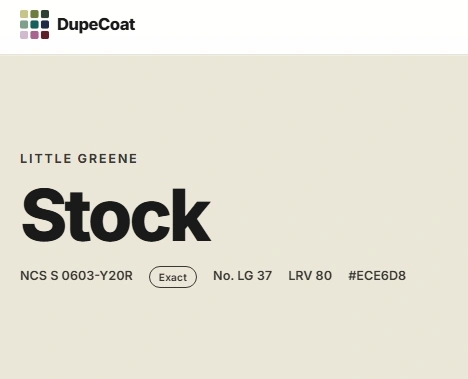
| Stock LG 37 | #ECE6D8 | 80 | S 0603-Y20R | Exact | 0.71 |
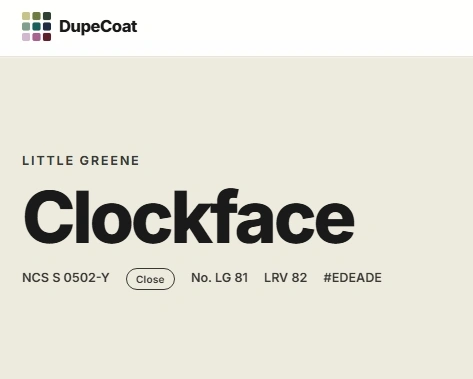
| Clockface LG 81 | #EDEADE | 82 | S 0502-Y | Close | 1.16 |
Stock is the warmer of the two and sits a touch deeper at LRV 80 against Clockface's 82. Stock carries a yellow-red cast, NCS S 0603-Y20R; Clockface is an almost pure yellow at S 0502-Y with half the chromaticness. That is the whole difference: Stock has a little more colour in it, Clockface is nearer to a plain soft white.
The comparison nobody makes, which matters more
Little Greene sells Stock in four strengths, and the gap between Stock and Stock Mid is 3.69 dE. That is more than double the gap between Stock and Clockface.
So the agonising is happening at the wrong end. If Stock looks close to right but not quite, the colour you want is probably further along its own family rather than across at Clockface. Here is every pair, ordered by how far apart they actually are.
| Pair | dE | How the second reads against the first |
|---|---|---|
| Stock vs Clockface | 1.65 | slightly lighter and a touch cooler |
| Stock mid vs Stock deep | 2.48 | noticeably darker, a little more saturated and a touch warmer |
| Stock deep vs Stock dark | 3.26 | noticeably darker, a little more saturated and noticeably warmer |
| Stock vs Stock mid | 3.69 | noticeably more saturated and noticeably warmer |
| Stock mid vs Clockface | 5.23 | slightly lighter, noticeably more muted and noticeably cooler |
| Stock vs Stock deep | 5.49 | noticeably darker, noticeably more saturated and noticeably warmer |
| Stock mid vs Stock dark | 5.73 | noticeably darker, noticeably more saturated and noticeably warmer |
| Stock deep vs Clockface | 7.09 | noticeably lighter, noticeably more muted and noticeably cooler |
| Stock vs Stock dark | 8.48 | noticeably darker, noticeably more saturated and noticeably warmer |
| Stock dark vs Clockface | 10.03 | noticeably lighter, noticeably more muted and noticeably cooler |
The whole Stock family
| Colour | Hex | LRV | NCS shade | Fit | dE to NCS |
|---|---|---|---|---|---|
| Stock LG 37 | #ECE6D8 | 80 | S 0603-Y20R | Exact | 0.71 |
| Stock mid LG 173 | #F0E3CD | 78 | S 0505-Y30R | Close | 1.3 |
| Stock deep LG 174 | #E8D9C0 | 71 | S 0907-Y30R | Exact | 0.61 |
| Stock dark LG 175 | #DFCDAF | 63 | S 1510-Y20R | Close | 1.23 |
The family runs from LRV 80 down to 63, getting warmer and more saturated as it goes. Stock Dark is 8.48 dE from plain Stock, which is a different colour by any measure.
What about Chambré?
We do not carry a Little Greene Chambré, so there is no measured comparison for it here, and we are not going to estimate one from a photograph. Everything above is measured against the NCS shade a trade tin is mixed to; a colour we cannot match is a colour we cannot measure.
If neither is quite right
Both colours sit in a crowded part of the off-white range, and the nearest neighbours cross brands. Stock's closest are Fired Earth Oyster at 0.8 dE, Sherwin-Williams Ivory lace at 0.8 dE, Sanderson Cameo white at 0.8 dE. Clockface's are Benjamin Moore Snow on the mountain at 0.4 dE, Benjamin Moore Vapor at 0.6 dE, Little Greene Linen wash at 0.6 dE. Anything under 1 dE there is closer to the original than most people's memory of the colour they saw in the shop.
Whichever you land on, order the tester. Stock and Clockface are 1.65 dE apart on paper, and the light in your room moves colours further than that before lunchtime.
Frequently asked questions
- What is the difference between Little Greene Stock and Clockface?
- Measured, 1.65 dE, which is the band where you would need the two side by side to see it. Stock is the warmer of the two, at LRV 80 with a yellow-red cast (NCS S 0603-Y20R). Clockface is lighter and cleaner at LRV 82 on an almost pure yellow (NCS S 0502-Y) with half the chromaticness.
- Is Clockface warmer or cooler than Stock?
- Cooler, and slightly lighter. Against Stock it reads slightly lighter and a touch cooler.
- Which should I use in a north-facing room?
- North light is cool and will pull both of them colder, so Stock's extra warmth usually holds up better there, and Clockface can tip towards grey. That is a tendency rather than a rule: the furniture, the floor and the window all push a colour around more than 1.65 dE. Put both testers on the same wall and look at them at the hour you use the room.
- How different are Stock and Stock Mid?
- 3.69 dE, more than double the gap between Stock and Clockface. If Stock is close but not quite right, the Stock family is where to look before crossing to another colour.
- Can I get Stock or Clockface in trade paint?
- Yes. Both map to an NCS shade a trade merchant can tint to: Stock to S 0603-Y20R and Clockface to S 0502-Y, graded exact and close respectively. Each colour's page shows the trade products, the price and the measurement.